

Tapas: What Remains After The Fire

How has your week been?
I am writing this at the airport, heading back home after an eventful first 3 months and a half of 2026. Finally feeling my guard relaxing a bit, my nervous system resetting. There's this particular kind of quiet that gradually happened this month as we ended something meaningful: the Yoga Teacher Training.
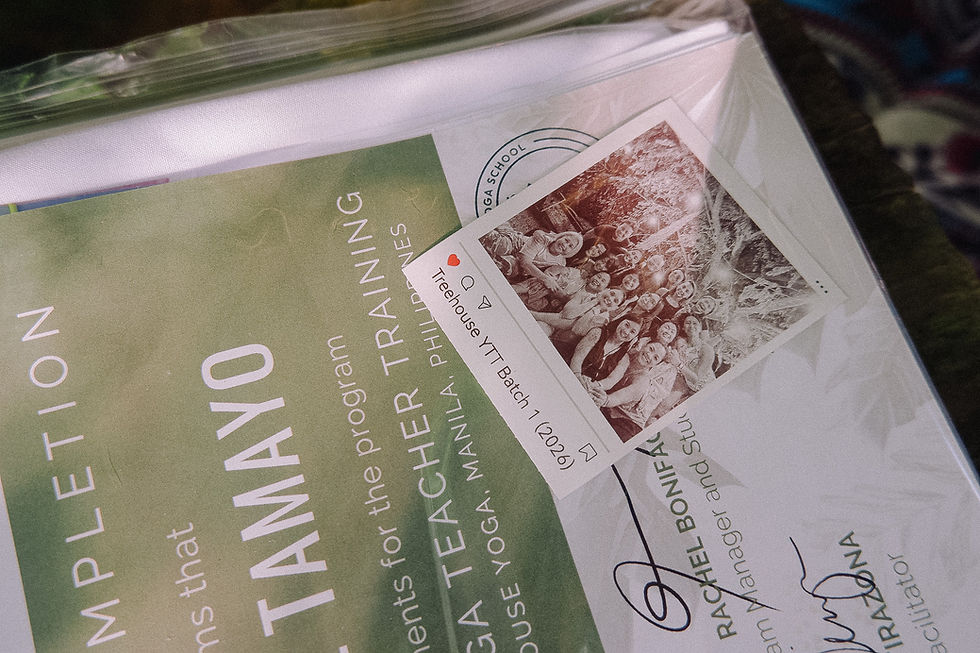
Most of you know how busy it has been for me and the rest of the teachers involved in the YTT. Not just for the faculty, but also for the rest of the team who attended the sessions and carried the weight of our absence, and, as someone who's always "absent," I never take this kind of teamwork lightly— I value it so much. (Though, I think most teachers would probably say I am almost never really absent, just not visible at the studio. AMIRITE!)
Last weekend, we finally held our first YTT graduation at Al's Cabins in Silang, Cavite. Teachers Ria, Kim, Jinky, and I were there a day ahead for some R&R, and Teacher Chantal came super early the following day. This allowed us to breathe and savor the work we put together. Our TMI would be this: last weekend was probably the first time we had slept that soundly since the YTT started.


Are we done?? Well, guess what? The journey has just started!
What Tapas Really Means
In the classical sense, tapas comes from the Sanskrit root word tap, meaning “to heat,” “to burn,” or “to undergo discipline.”
But in lived experience, Tapas is not about punishment or force. It is, in fact, the kind of effort that refines you. Something so consistent and so subtle and simple that it is enough to change you or define you.
For all of us, this may show up in everyday ways of being, like waking up early, even when your body resists. Or returning to your asana practice after a difficult week ... or even after years of hibernation. (Hello to our returning yogis! So glad to see you back!)
But this month, let me tell you how this theme was intentionally selected, not just for where we all are in our yoga practice right now, but also for the season (tapas = heat, summer!) and for the YTT graduation month.
For our dear graduates, Tapas may have already showed up for you. Teaching your first class, despite uncertainty and self-doubt, or staying present when it would be easier to withdraw, or finding the easier route into the yoga teaching system (IYKYK). You see, Tapas is not intensity but the continuity of your intention. And this is what you have practiced, and hopefully embodied, in your training— not just asana, not just sequencing, not just anatomy.
You, our beloved new teachers, have practiced staying.
Training Is Over. Now What?
Our weekends are now back to normal, woohoo! Now what are they supposed to do?
Well. Not everyone will teach yoga immediately. Some might not even teach publicly... or ever. Or not in a way they initially imagined post-training to look like.
And you know what? That's okay.
Yoga Teacher Training is more than just teaching people how to teach yoga. It is, first and foremost, a tough process of meeting yourself where you are. It can be a scary thing, like looking at a big mirror and seeing all your struggles, your deepest, darkest intentions, the bad and the ugly parts of yourself. (It is for everyone, but, I have to say: not everyone is ready or would ever have the courage for something like this.)
But the YTT is also Tapas at work: staying and saying, "This is okay. I can be both perfectly imperfect and a work in progress at the same time."
Now that training is over, apart from their acquired skills to teach yoga, our trainees graduate from the program with a deeper capacity to observe, a more refined relationship with effort, an understanding that practice is not performance, and the ability to stay present with what is actually happening. They have become a bigger vessel to hold what needs to be held.
As we have posiitioned the overarching theme for this year, these things they learned are all transferable skills for living.


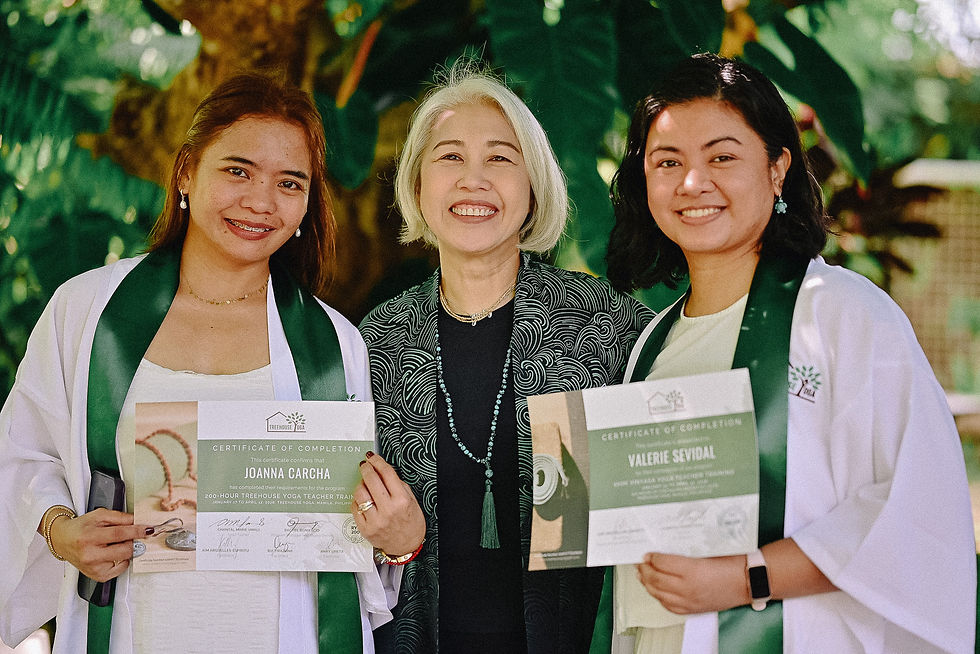
A Message To Our New (And Experienced) Yoga Teachers
Whether you are teaching your first class or your hundredth, there is a quiet pressure that can creep in: To be liked. To be clear. To be impressive. To be enough.
Honestly, it doesn't matter how long you teach yoga or whether you own a yoga studio, or if you've become a self-proclaimed guru at the top of a mountain. If you have developed your ability to observe and notice your ego, you will constantly experience all of this. There's nothing wrong with it; it is simply part of being a human being. We acknowledge it and we reset back to service.
Teaching yoga was never meant to be a performance of mastery. Instead (and maybe this is just me talking about the Treehouse brand), I think being a yoga teacher is a conscious, endless practice of participation.
On the mat, it is easy: you instruct, you guide, you lead. But off the mat and how you live your life and make decisions, how you show up for yourself and for others when "students" are not present and not actively watching? Now, that is real teaching.
Remember that Tapas with structured practice (on the mat, on the meditation cushion, in formal training, at work, etc.) is just the tip of the iceberg. Yoga is really but a platform that offers space for deeper, oftentimes unstructured, internal work.
What has been built is not the training itself—but your capacity to remain in the work.
There will be moments when you feel clear, and moments when you do not. There will be classes that land beautifully and would make you feel like you've nailed it all. And there will be classes that will not, and you will replay them in your head... or forget about them. There will be days when practice and teaching will feel meaningful and connected to your purpose, and there will be days when it will feel mechanical. There will be communities that will love you and embrace you, and there will be those that will make you feel like an alien.
Those are all okay.
Tapas is what allows you to stay through all of it—without hardening, without checking out. Not because you have to, but because you understand that teaching does not come from intensity and headstands.
Teaching comes from continuity with care.
Whether you'll end up with Treehouse or otherwise, this is something we would like you to keep in mind.
If the program (or this community) has changed you for the better, then to me, it has already done its job. It already succeeded.

Tapas For All!
As we step out of the structure of mats and into the openness of our own practice (and/or teaching), we hope you know that you do not need to become anything more. You only need to keep returning to what gives you joy, meaning, purpose, and warmth.
Gently. Consistently. Honestly.
As for us Treehouse Teachers...? Well, we are constantly cooking something up for you. You know this!
I bow to you all in gratitude and respect,
Rachel
--
Photos by Arts Enriquez and Bettina Chua


My overall impression of this game is positive because it offers a Sikkimgame simple and accessible interface. The controls and menu options are relatively easy to understand, even for beginners. There is always room to improve the experience through better performance and fresh content. Regular updates, clear information, and responsible gaming features would be valuable additions in the future.